The battery should be stored under the following conditions.
(1) Low humidity
(2) 5 to 122oF(-15 to 50oC)
(3) Clean, and avoid direct sunlight.
2. Capacity after Long Term Storage
After long term storage, all batteries deliver less than rated capacity on first cycle. In cyclic application, full capacity may be obtained through several charge/discharge cycles, typically 2-3 cycles.
3. Refresh Charge
When batteries are placed in extended storage, it is recommended that they receive a refresh charge at recommended intervals as following;
Refresh charging method:
3 a 5 hours of constant current 0.1C Amps or 12 a 16 hours at constant voltage of 2.45V/cell
Storage Ambient
Recommended interval
Below 20 °C(68°F)
12 meses
20 to 30°C(68 to 86°F)
6 moths
30 to 40°C/86 t0 104°F)
3 moths
4. “Self Life”- typical capacity vs. time
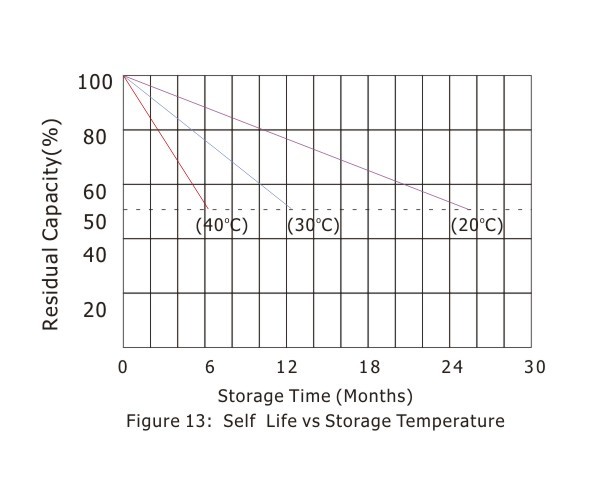
Self-discharge rate is very much dependent on the storage temperature as shown in Figure 13.Lower temperatures allow the battery to be stored for longer periods. (Each ten degree centigrade drop results in a halving of self-discharge rate and doubles storage time.)
5. “Self Life”-storage time vs. temperature
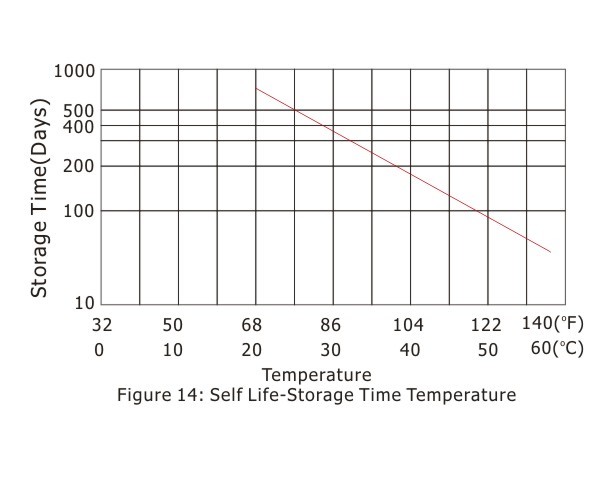
Cifra 14 shows the time for the capacity to decrease to 50% of nominal capacity at each temperature during storage. If the storage temperature is known, the graph may be used for finding the most useful recommended refresh charge intervals.
6. Open Circuit Voltage and Residual Capacity
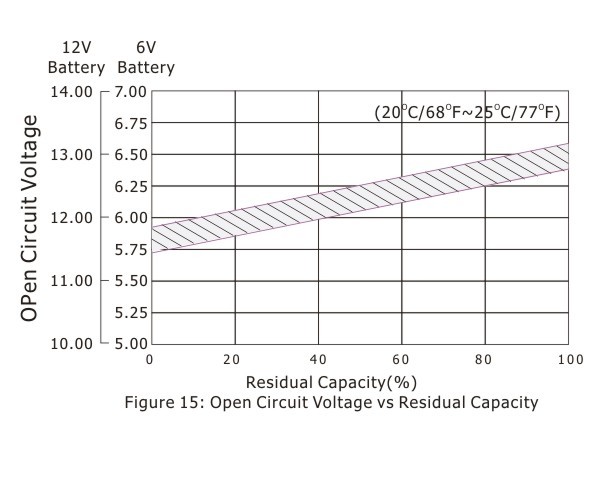
Residual capacity can be estimated by measuring the open circuit voltage as shown in Figure 15.
7. Resistencia interna de la batería
The internal resistance of a battery is lowest when the battery is in a fully charged state. The battery internal resistance will be increased gradually during discharge.